
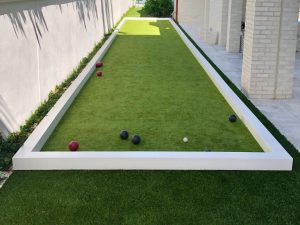
Every bocce player has a favorite surface, and none of them will be talked out of it. Florida makes the debate messier. We get afternoon downpours that dump an inch in twenty minutes, salty air that gets into everything, and a summer sun that bakes whatever it hits. A surface that behaves in Italy or New England can fall apart here, which is why a growing number of homeowners are asking about synthetic turf bocce ball courts in Palm Beach and elsewhere in the state. Before picking one, it’s worth knowing what you’d be signing up for with each.
Table of Contents
Rain first, because it decides most things
In Florida, drainage is the first thing to look at.
Clay is the worst offender. It holds water, and a court can sit unplayable for a day or longer after a heavy storm. Shell and stone dust shed water faster, but the fine particles settle and pack down over the years, and the drainage slows with them.
Turf over a well-built base is a different story. Standard ASTM testing puts the turf material at over 100 inches per square yard per hour. Underneath, a porous base of 57 stone topped with 89 stone lets water keep moving down instead of sitting on the surface. Palm Beach County gets storms nearly every summer afternoon, so being able to play once the rain stops matters more than it sounds. It’s a big part of why synthetic turf bocce ball courts in Palm Beach keep getting more popular.
Oyster shell
Shell is the classic. It’s bright white, and a lot of people love the crunch of a ball rolling over it. If you’ve ever maintained an oyster shell bocce ball court, though, you know the trade-off. The shell migrates as people play, so you’re constantly raking it back, rolling it flat, and ordering more. It gets dusty when it’s dry, and a big storm can leave it lumpy. Someone who loves the ritual won’t mind any of that. Someone who wants to throw a few balls after dinner probably will.
Clay and stone dust
Clay can be wonderful, but only in a narrow band of moisture, damp but not wet. Florida rarely stays in that band for long. Too dry and it cracks and goes rock hard, and too wet and it turns to paste.
Stone dust, which is just crushed rock fines, is cheaper to put in and packs down firm. Then the rain arrives. It rusts, washes out in places, grows weeds, and needs re-leveling from time to time. Both of these surfaces need an owner who’s willing to keep an eye on them.
How each one rolls
A traditional oyster shell bocce ball court is quick but a little jumpy, since every fragment is a small bump in the ball’s path. Clay is a gamble. When it’s prepped well, it’s about as true as a surface gets, and when it isn’t, it’s the slowest of the bunch. Stone dust plays fast at first, but once ruts form, they start steering the ball where you didn’t aim it.
Turf is the steadiest option. A short, dense pile with sand infill gives a predictable roll, and you can adjust the pace by changing the pile height or the amount of infill. Humidity and rain don’t change how it plays.
The upkeep
Here’s what each surface asks of you:
- Oyster shell: raking, rolling, topping up, and dealing with dust
- Clay: watering, rolling, patching, and waiting out rain delays
- Stone dust: re-leveling, pulling weeds, and fixing ruts after storms
- Synthetic turf: occasional brushing and infill top-ups, and no mowing, watering, or fertilizing
Turf wins this comparison easily. Heavy traffic can flatten the fibers over time, but firmer fibers and an occasional power-brushing take care of most of it.
Waterfront and coastal yards
Salt air, sandy soil, and the occasional storm surge make coastal properties tougher still. When water moves across the yard, shell and stone dust shift or wash out, and clay can turn into a swamp. A turf court built on a compacted base inside a timber frame stays where it was built.
Heat is the one real drawback. In direct sun, turf can climb well past 160 degrees. To deal with that, installers use HydroChill-coated infill, which holds moisture and cools the surface as the water evaporates. For anyone looking at synthetic turf bocce courts in Naples, that detail deserves more thought than almost anything else. SouthWest Greens built a 1,800 sq ft court on a pool deck in Marco Island, so we’re no strangers to heat and tight spaces.
If your HOA pushes back
Some HOAs and community boards resist synthetic turf, usually out of worry about drainage. For synthetic turf bocce ball courts in Palm Beach, that worry doesn’t hold up against the testing, and showing up with paperwork tends to settle it. Bring turf spec sheets with the drainage test results, a drawing of the base layers and borders, and the court’s size and exact location on the property. It also doesn’t hurt to mention that turf means no watering, no dust blowing over to the neighbors, and no mud tracked into the house.
FAQs
Which bocce court surface is easiest to maintain?
Synthetic turf. It needs occasional brushing and infill top-ups, while shell, clay, and stone dust all call for regular raking, rolling, or re-leveling.
Which surface drains best?
Turf over a porous stone base drains fastest. Clay is the slowest and tends to stay wet after heavy rain.
Is turf a good fit for coastal properties?
Yes. It stays in place when water moves across the yard, and cooling infill like HydroChill handles the heat from direct sun.
Shell and clay have a history, but turf takes far less work, and for most Florida yards, that’s what decides it.
Thinking about building a court? SouthWest Greens is at 7481 SW Jack James Dr, Stuart, FL 34997. Call 561.694.1557 or visit swgreens.com .